Introduction
The previous article set the framework:
- An architectural observation at Saqqarah,
- A singular numerical organization,
- And a gradual back-and-forth between stone and text.
But one historical piece deserves to be examined in its own right:
the Famine Stele.
Before any hypothesis of identification, before any symbolic reading, this inscription must be analyzed for what it is.
1. A late stele, an ancient narrative
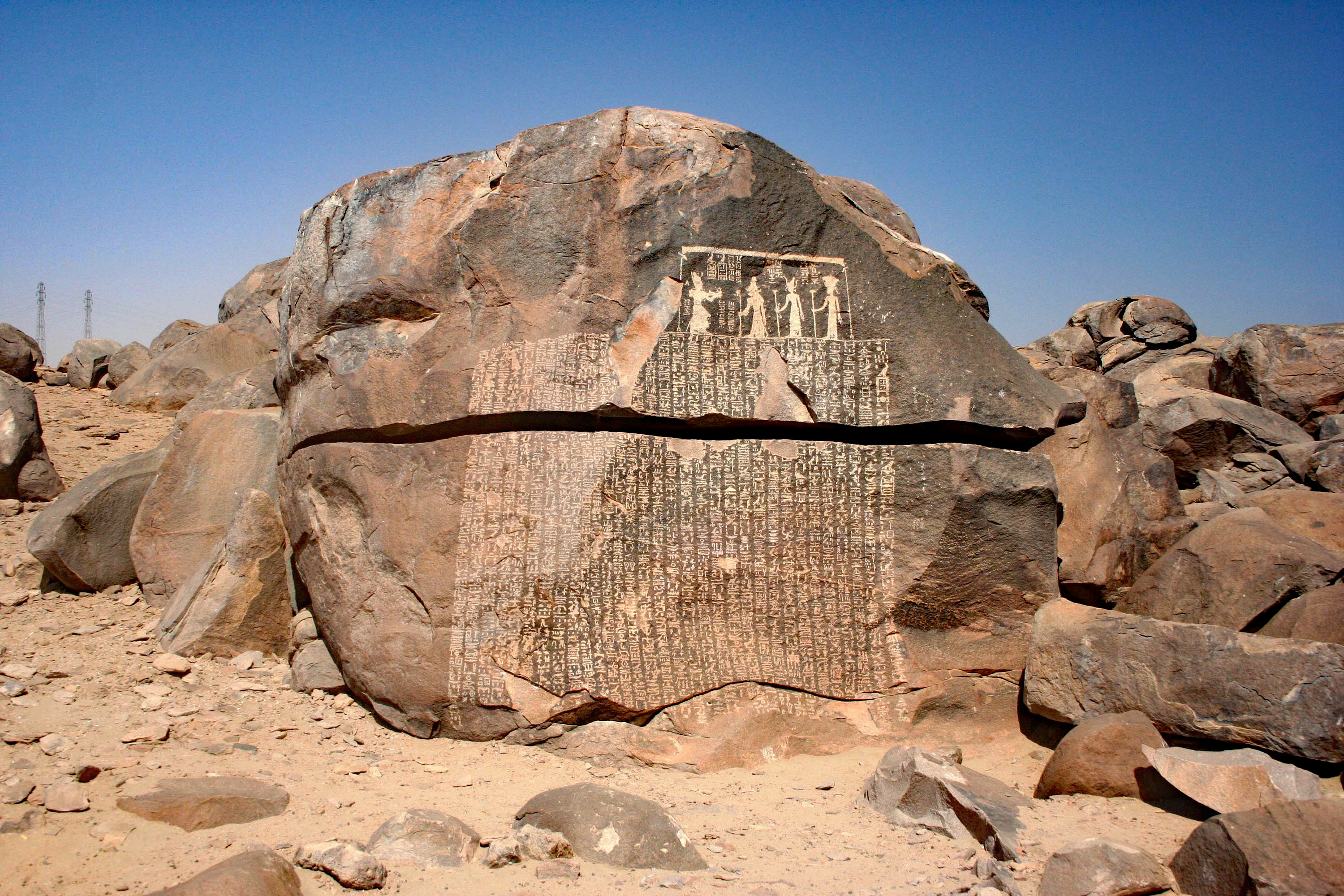
The Famine Stele is located on the island of Sehel, south of Aswan.
It was discovered at the end of the nineteenth century and dated to the Ptolemaic period (third-first century BCE).
This point is essential:
The inscription is late.
It does not date from the reign of Djoser (Third Dynasty), but claims to report an event that occurred in his time.
The text mentions:
- A famine of 7 years.
- An insufficient flood of the Nile.
- An anxious king.
- The intervention of a wise man named Imhotep.
- Administrative and religious measures to restore order.
These elements are attested in the inscription.
They are not a modern interpretation.
2. The historical limits of the stele
Before going further, the limits must be stated:
- The stele is Ptolemaic.
- It may reflect a late reconstruction.
- It may be a theological-political narrative.
In other words:
It is not direct historical proof from the third millennium BCE.
But it bears witness to a memory.
And this memory associates:
- Djoser, the king,
- Imhotep, the wise man,
- A famine of 7 years.
3. The Quranic parallel
In Surah Yusuf (No. 12), the narrative is structured around:
- A royal dream.
- 7 years of abundance.
- 7 years of famine.
- (1) year in which the situation is restored.
- A rational organization of resources.
- The appointment of a wise man as administrator.
The laboratory considers the Quran to be the primary scriptural source.
But the question here is not theological.
The question is comparative:
How can we explain that a late Egyptian narrative mentions a 7-year famine under Djoser, with Imhotep as adviser?
And that the Quranic narrative relates a 7-year famine in Egypt, under the authority of a wise man summoned by the king of Egypt?
We do not conclude. We observe.
4. The number "7": "recurring motif" or "coincidence"?
The number 7 is universally present in many cultures.
It can therefore be invoked as a generic symbol.
But here, the context is precise:
- Famine.
- Egypt.
- Central authority.
- Management of resources.
It is not a simple isolated number. It is a narrative structure.
5. The role of Imhotep
Historically, Imhotep was:
- Architect of the Djoser complex.
- High dignitary.
- Priest.
- Physician.
- Sage.
He was one of the rare non-royal figures to be deified after his death.
This exceptional status raises a question:
Was he simply a versatile genius? Or rather, A figure who played a major political role in a national crisis?
The Famine Stele presents him as:
Mediator between the king and the divine.
The Quranic narrative presents Yusuf as mediator between the king and providence. In other words:
A Prophet.
The convergence is structural. It calls for examination.
6. What the stele does not prove
It does not prove that:
- Imhotep = Yusuf.
- The Quranic narrative alludes to this same history.
- The chronology is identical.
It establishes only:
- A memory of a 7-year famine under Djoser.
- A figure of a wise administrator named Imhotep.
- A link between political power, knowledge, and divine intervention.
For this inquiry, it is a historical starting point.
- Archaeological from the point of view of the stele, dated to the third century before our era.
- Scriptural from the point of view of the Quran, a book officially dated to the seventh century.
7. An inscription as catalyst
Thus, the Famine Stele does not constitute a conclusion. It constitutes a trigger.
It is what makes the question legitimate:
What if the narratives were not independent from one another? It is what authorizes the inquiry.
Conclusion
The Famine Stele is a late document. It is historically complex. It is not proof. But it is not neutral either.
It connects:
- Djoser,
- Imhotep,
- A famine of 7 years,
- And providential management.
Within the framework of a cross-disciplinary inquiry between architecture, history, and the Quranic text, it is a piece that cannot be ignored.
The question remains open.
And it is this question that will guide the examination of the Saqqarah complex in the next article.